How Watsynq Works
Three heterogeneous sensor streams. One physics-informed fusion model that outputs a Remaining Useful Life score with uncertainty bounds.
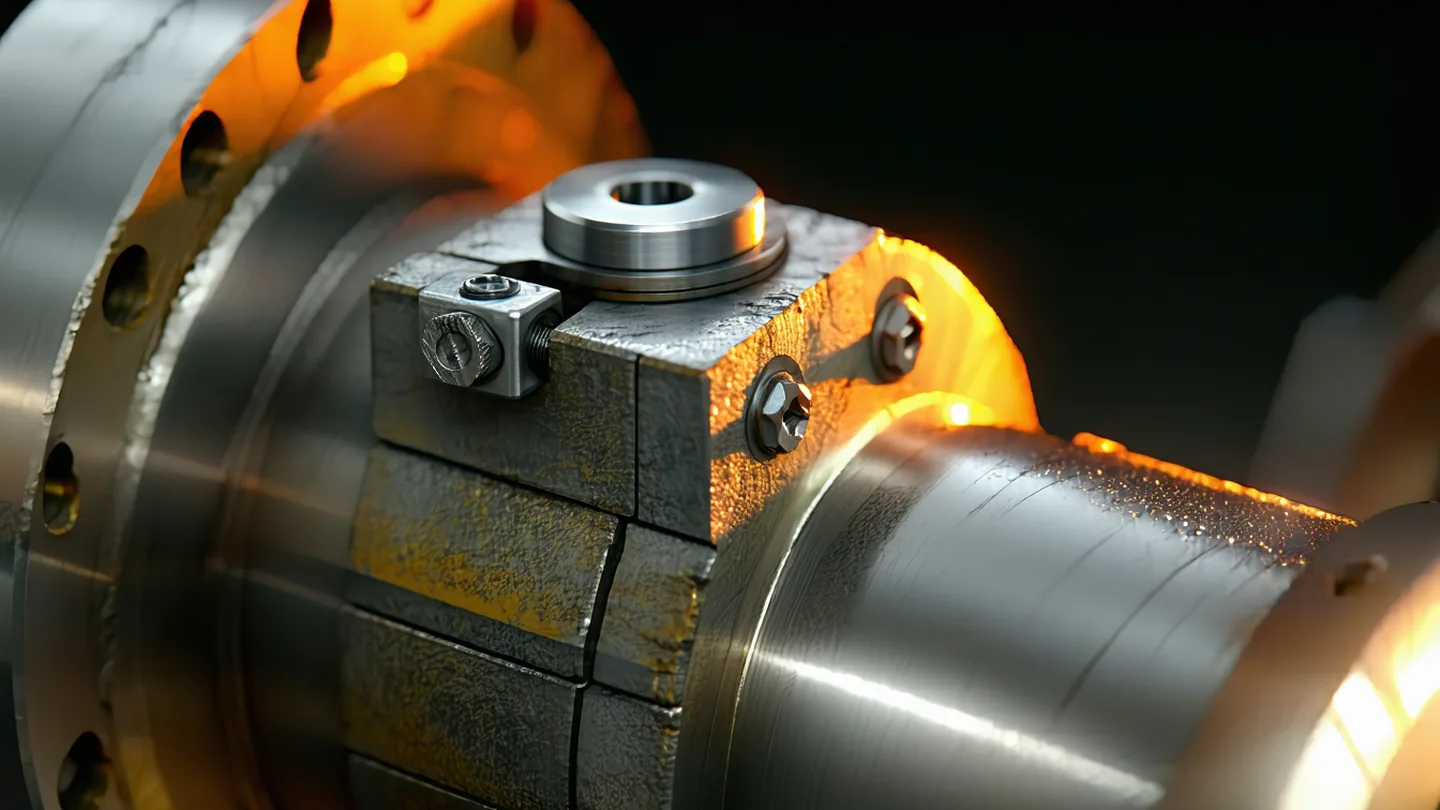
Clip-on sensors. No process stop.
Acoustic emission clamps on the housing exterior. Oil particle counter inline-taps the existing lube circuit. Surface thermal sensor adheres to housing with thermal paste.
- AE sensor clamps on bearing housing exterior — no bore-in fitting required
- Oil particle counter taps into existing lube line — no process shutdown
- Surface thermal sensor adheres with thermal paste — 5-minute install
- Typical install per monitoring point: under 4 hours
Bearing Assembly — Sensor Placement
From edge sensor to RUL score.
Encrypted transmission, timestamp normalisation, signal alignment, and stage-adaptive physics weighting — all in the cloud pipeline. No data science team on-site. No custom model maintenance by the plant.
Not just ML. Physics-informed fusion.
The model knows which signal matters at which failure stage — and adjusts weighting accordingly.
Failure mode library: 180+ bearing, gear, and impeller defect signatures indexed by equipment class. The model matches your equipment type before it starts scoring.
Stage-adaptive weighting: Acoustic emission is weighted highest in early-stage defect where stress waves precede structural damage. Thermal weighting increases in advanced stages where bearing friction raises housing temperature asymmetrically.
Uncertainty quantification: Bayesian posterior on RUL — not a point estimate. You see the confidence interval and the underlying signal contributions at every update.
Signal weight by defect stage
What you see and what it means — line by line.
Every alert has enough context for a maintenance planner to act without opening a second tool.
Ready to see a live RUL output for your equipment type?
We will walk through the physics, show you a real alert output, and map installation to your specific equipment class. No slides.