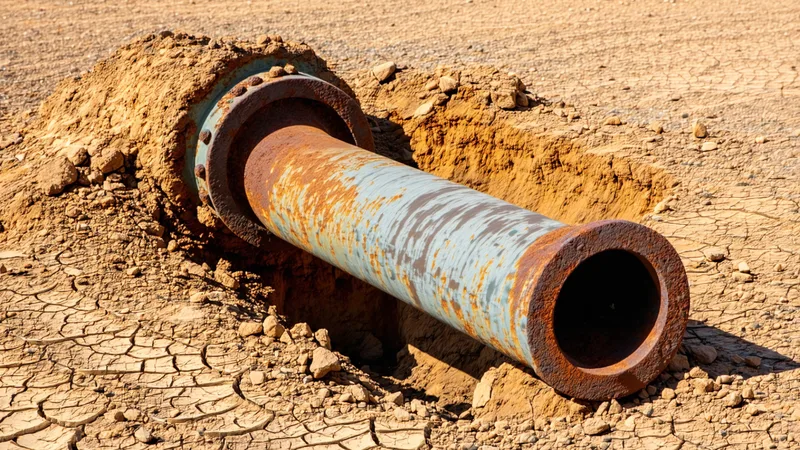
When the water infrastructure conversation turns to crisis, attention usually lands on cities with visible, dramatic failures — Flint, Jackson, the Northeast's crumbling century-old cast iron systems. The Southwest doesn't get the same coverage. That's a mistake, because the failure mode building under Phoenix, Tucson, and Albuquerque is distinct, less visible, and in several ways harder to manage than a simply old pipe system.
The problem in the Southwest isn't just pipe age. It's pipe age combined with an environmental stress regime that most of the original pipe standards weren't designed for — and a water scarcity context that makes every gallon lost to a break or repair-related flush a compound problem.
What was installed and when
The rapid postwar expansion of Phoenix and its surrounding municipalities created a large volume of water distribution infrastructure laid between roughly 1955 and 1985. The dominant pipe materials in that era were unlined cast iron, asbestos cement (AC), and early-generation ductile iron. In the Phoenix metropolitan area, a reasonable estimate — based on publicly available utility asset inventory data and AWWA distribution surveys — is that between 25% and 40% of distribution mains still in service were installed before 1980.
Unlined cast iron mains from that era have a design service life that is commonly cited at 75–100 years under typical Northeastern soil and climate conditions. That characterization does not translate cleanly to the Sonoran Desert. The actual service life is shorter under Southwest conditions for reasons that are worth examining in detail.
The arid soil problem: caliche and shrink-swell dynamics
Phoenix-area soils are dominated by caliche — a calcium carbonate-cemented layer that sits at varying depths throughout Maricopa County. Above the caliche layer, fine alluvial soils with moderate to high montmorillonite clay content are common. Montmorillonite is an expansive clay: it swells significantly when wetted and contracts when dried. In a climate with 8–10 inches of annual rainfall concentrated in brief monsoon events, and summers that drive soil moisture to extremely low levels, the shrink-swell cycling imposed on buried pipe is substantially more severe than in temperate humid climates.
The practical consequence for cast iron and AC pipe is progressive joint deflection. As the soil moves seasonally, pipe joints — bell-and-spigot joints in cast iron, rubber-gasketed compression joints in AC — experience lateral forces they were not designed to accommodate indefinitely. The cumulative effect is joint pullout, localized stress concentration at the joint face, and eventual cracking that propagates circumferentially. This failure mode is distinct from the longitudinal corrosion pitting that dominates in humid Eastern climates, and it affects pipe joints rather than pipe body, which means traditional acoustic leak detection approaches (which locate the leak point) may identify water loss well before the structural failure that eventually becomes an emergency.
The drought amplification effect
Three consecutive below-average water years on the Colorado River system (2020–2023) drove Arizona to Tier 1 and subsequently Tier 2 shortage declarations under the Colorado River Compact. The operational response by municipalities — accelerated groundwater pumping, distribution system demand management, reduced non-essential flushing — had a secondary consequence that deserves attention.
Reduced system pressure and reduced flushing frequency during demand management periods affects the internal corrosion environment in unlined cast iron mains. Tuberculation — the progressive buildup of iron oxide nodules on the interior pipe wall — accelerates in conditions of low-velocity, low-turnover flow because the corrosion products are not continuously scoured by flow. The C-factor degradation that results reduces hydraulic capacity and increases pumping energy cost; more importantly for structural purposes, severe tuberculation is associated with reduced pipe wall thickness and increased susceptibility to transient-driven cracking.
At the same time, the severe soil moisture depletion during prolonged drought conditions increases the shrink-swell differential during monsoon wetting events. The first significant monsoon storm after a severe drought season imposes some of the highest strain-rate conditions that aging distribution mains will ever experience. This is not a hypothetical: utilities in the Tucson and Phoenix areas have documented elevated break rates in the weeks following the monsoon season onset, and the pattern is consistent with the soil mechanics.
The inspection deficit
The infrastructure assessment challenge in the Southwest is compounded by limited inspection history. CCTV inspection of distribution mains — standard practice for gravity sewer systems in most municipalities — is far less routinely applied to water mains because the continuous pressurized operation makes access difficult and expensive. Most Southwest utilities have condition data for less than 5% of their distribution network derived from direct inspection. The balance of condition intelligence comes from break history records (which are reactive, by definition), age-based deterioration curve estimates from the AWWA M36 methodology, and periodic C-factor testing (which is resource-intensive and typically deferred).
The result is a condition knowledge gap that is structural, not just operational. Utility leadership knows the pipe is old. They know certain corridors break more frequently. But they lack the granularity to confidently answer the question that capital planning requires: which specific segments should be replaced in the next budget cycle, and which can wait five more years?
Why the data-forward approach is not optional
The infrastructure replacement backlog in Southwest water systems represents capital requirements that no utility in the region can fund in a compressed timeframe. The AWWA has estimated the national water infrastructure funding gap at well over $1 trillion over 25 years; the Southwest's share of that, adjusted for accelerated deterioration conditions, is disproportionately large relative to population served.
The implication is that prioritization quality — getting maximum risk reduction per dollar of capital deployed — matters enormously. A utility that replaces a mile of pipe in a corridor that would have been fine for another 15 years, while leaving a genuinely critical segment unaddressed, hasn't just wasted capital; it's deferred the emergency that drives the next rate increase and the next public trust crisis.
We're not saying that data systems replace engineering judgment or that predictive analytics is a substitute for a funded capital replacement program. The physical work of replacing deteriorating pipe is unavoidable and expensive regardless of how well you prioritize it. But data-informed prioritization, applied consistently across the entire network, materially improves the expected value of each capital dollar spent. In a region where water scarcity and infrastructure age are both trending in the wrong direction simultaneously, that improvement is not a luxury — it's a competitive necessity for utilities that need to keep rates at levels their communities can support.
The crisis is already underway. It's happening underground, one joint at a time, and it isn't getting coverage because the individual failures are still manageable. The question is whether Southwest utilities will act on the pattern before it produces a failure rate that the regional water system can't absorb.
Ethan Morales is CEO and Co-Founder of Watsynq, based in Phoenix, Arizona.