The AWWA has published its manual on water main condition assessment practices — the guidance that serious utilities use when building a systematic inspection program — and the methods it describes are genuinely effective. CCTV inspection, acoustic leak detection, inline electromagnetic inspection tools, and physical sampling provide condition data on individual pipe segments that no statistical model can replicate. Direct inspection produces ground truth. Predictive analytics does not.
That distinction matters because the two approaches are sometimes framed as competing alternatives: "Should we buy inspection services or predictive software?" That framing is wrong, and understanding why requires being clear about what each method actually does well and what it can't do.
What physical condition assessment does well
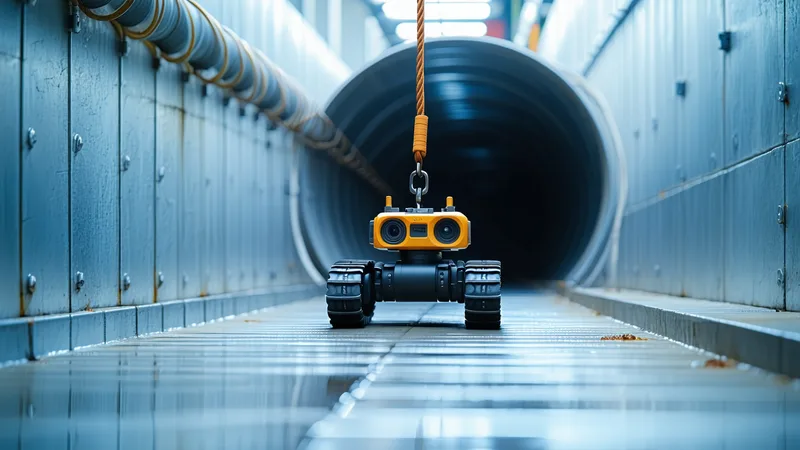
The methods catalogued in AWWA guidance — and discussed in detail in publications like the AWWA Research Foundation's pipe condition assessment research — provide direct, physical evidence of pipe condition at the point of assessment. A CCTV camera traversing a 200-meter pressurized main (using a bypass configuration) produces visual evidence of wall corrosion, joint separation, and tuberculation that a pressure historian cannot replicate. An acoustic logger placed overnight on a valve measures the leak signal frequency spectrum directly; there's no inference or model — either there's an acoustic signature consistent with a leak or there isn't.
Electromagnetic inspection tools — SmartBall, P-Wave, and similar technologies — go further: they can characterize wall thickness and detect pitting corrosion across the pipe body, not just at the surface or at joint locations. These tools represent the current state of the art for distribution main condition assessment. They're also expensive: inline inspection of a distribution main typically runs $15–40 per linear foot depending on diameter, pipe material, and access complexity. A utility with 280 miles of distribution mains would spend $22–56 million to inspect every foot — once.
The inspection budget constraint is the key context. No utility inspects its entire network at any meaningful frequency. The question is always: which segments do you inspect this cycle, and which do you defer?
What predictive analytics does — and what it doesn't
Predictive analytics operates on aggregate signals: pipe attribute combinations, operational pressure data, soil characteristics, and spatial break history patterns. It produces a probability ranking — a statement about which segments are statistically more likely to fail than others, based on the features that correlated with historical failures. It does not produce a wall thickness measurement. It does not detect an active leak. It does not confirm that a specific pipe joint has separated.
We're not saying predictive analytics replaces physical inspection — it doesn't, and any vendor claiming otherwise deserves skepticism. What it does is answer the question that physical inspection can't answer efficiently: across a 280-mile network, which 10 miles should we inspect this year?
The combination of the two is what produces maximum risk reduction per dollar spent. If your inspection budget is $500,000 per year and that covers roughly 25 miles of acoustic and visual survey, applying that budget to the 25 highest-risk miles identified by the predictive model will find substantially more compromised pipe than applying it to the 25 miles that seem oldest on paper, or the 25 miles that were last inspected longest ago. That prioritization improvement — concentrating inspection resources on segments where the probability of finding something actionable is highest — is the primary value that predictive analytics delivers in a mature asset management program.
How inspection findings feed back into the model
The relationship between physical inspection and predictive analytics isn't one-directional. When inspection of a high-risk segment finds advanced wall thinning or joint separation, that finding is evidence that the model's risk signal for that segment was accurate — a validation data point that can be used to calibrate confidence in similar high-risk predictions elsewhere in the network.
When inspection of a high-risk segment finds a pipe in unexpectedly good condition, that's also informative — it suggests either that the risk features for that segment type are overweighted, or that there's a missing variable (perhaps the segment was previously slip-lined, or has a protective coating that isn't recorded in GIS). That discrepancy becomes a training signal: the model should learn that segments with the specific attribute combination of that segment have lower conditional failure probability than the base model assumed.
This feedback loop — predictive model directs inspection, inspection results calibrate predictive model — is how utilities with mature programs progressively improve both their inspection efficiency and their model accuracy. It requires a data discipline that many utilities don't currently have: systematically recording inspection results in a format that can be linked back to the GIS segment record and ingested as model training data. That linkage is something Watsynq establishes explicitly during the integration phase, precisely because the feedback loop is central to long-term model performance.
The PCCP case: where inspection is non-negotiable
Prestressed Concrete Cylinder Pipe (PCCP) is a category where predictive analytics cannot substitute for physical condition assessment, and utilities with PCCP mains in their network should understand why. PCCP fails through a different mechanism than other pipe materials — progressive wire corrosion and prestress loss rather than wall thinning — and the failure mode is often sudden and catastrophic rather than gradual. The standard approach for managing PCCP is electromagnetic inspection that detects wire breaks directly; no pressure signal, soil variable, or break history pattern adequately captures the wire corrosion state.
If your distribution network or transmission mains include PCCP segments (especially large-diameter PCCP transmission mains, which are common in the Southwest), electromagnetic inspection of those segments is not optional, and a predictive analytics platform should not be positioned as an alternative to it. The two should exist in parallel: electromagnetic assessment for PCCP, model-directed acoustic and visual inspection for metallic distribution mains, and the combined risk picture informing capital replacement sequencing across both asset classes.
Building the integrated workflow
In practice, an integrated predictive-plus-inspection workflow looks like this: the predictive model produces a ranked list of segments at the start of each inspection planning cycle (typically quarterly or annually). The asset management team reviews that list against known constraints — which segments have already been inspected recently, which are in corridors with planned construction that would make inspection convenient, which are near known PCCP segments that require attention — and produces a prioritized inspection scope. Inspection is procured and executed. Results are recorded in GIS and fed back into the model. The capital replacement recommendation for the following budget cycle incorporates both the model's risk ranking and the physical condition data from segments inspected during the cycle.
The predictive layer and the inspection layer each reduce uncertainty about pipe condition. Used together, they reduce it more than either does alone. That's the only honest framing of the relationship between the two approaches.
Nadia Vasquez is Head of Data Science at Watsynq.