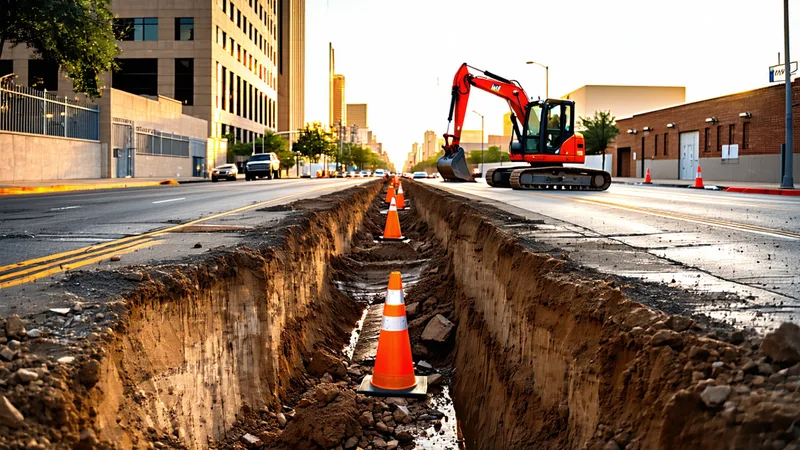
When I talk to operations directors about the cost of a main break, I usually hear a number somewhere between $4,000 and $8,000. When I ask how they arrived at that number, the answer is typically labor and materials for the repair itself — the crew hours, the pipe fittings, the concrete patch. That number is real. It's also about half of what an emergency excavation in a Phoenix suburb actually costs when you add everything up.
The full cost matters because it's the number that makes or breaks the ROI case for predictive maintenance. If you're working with $6,000 as your baseline emergency repair cost and the predictive platform costs $42,000 per year, you need to prevent seven breaks per year to break even. If the actual cost is $18,000 per event — because it's a commercial corridor and traffic control runs $4,500 and the pavement restoration is $3,200 and the liability exposure from the adjacent business is $1,800 — you only need to prevent three.
Where the money actually goes
Let's build the cost stack for a representative emergency excavation in a Phoenix metro commercial corridor. These are industry-realistic cost ranges, not claims about any specific utility's books.
Emergency crew labor: A typical emergency response deploys 4–6 crew members for 8–12 hours, including overtime premium for after-hours callouts. At loaded labor rates including benefits and overhead — not just base wage — this commonly runs $3,500–$6,000 for the initial response crew. If a second crew is required for an extended repair or if the wrong segment is excavated initially and a second dig is needed, this doubles.
Traffic control: A commercial or arterial corridor break requires lane closures, signage, traffic control personnel, and often police presence. ADOT's standard estimates for traffic control in urban Arizona corridors are $1,500–$5,000 per day for a two-to-four lane closure, depending on traffic volume and time of day. Emergency repairs that extend through a peak traffic period incur the highest costs.
Excavation and backfill: Equipment rental or fleet deployment, operator time, dewatering if the break has saturated the excavation site, bedding material, and compacted backfill. For a typical 12-inch main in caliche soil at 4-foot depth, this runs $1,200–$2,500 per excavation event, not counting any complications from utility conflicts.
Pavement restoration: In Arizona, temporary patching is followed by permanent restoration typically required within 30–90 days under municipal ROW permit conditions. Full-depth concrete or AC restoration in a commercial corridor runs $80–$180 per square foot depending on pavement type and thickness. A 10-foot × 10-foot excavation footprint = 100 sq ft = $8,000–$18,000 in pavement restoration alone. Most utilities track the repair cost but don't attribute the full restoration cost to the break event.
Customer impact and service restoration: Every hour of service interruption in a commercial area has an associated cost — typically not captured in the utility's accounts, but very real to the affected businesses. For a utility managing its regulatory relationship with the city, service disruptions in commercial areas accumulate into political pressure for infrastructure investment that eventually shows up in rate cases.
Water loss: A pressurized 10-inch main break flowing at typical rates loses 300–1,000 gallons per minute until the valve isolation is completed. For a utility purchasing Colorado River water at current CAP rates, the cost of the lost water is secondary — but in a scarcity environment where every acre-foot matters, it's a real cost.
The "wrong dig" multiplier
The cost above assumes the crew found the break on the first excavation. The AWWA's periodic member surveys have consistently found that for utilities responding to main break alerts without precise location data, the first excavation misses the break 20–35% of the time — the leak has migrated along the pipe exterior or the initial acoustic signal was ambiguous. Each additional excavation adds the full cost of the dig, traffic control, and temporary patching again.
At Watsynq, we track the "dig accuracy" metric for utilities using our segment-level risk map to direct repair crews. We're seeing dig accuracy — defined as confirming a structural failure or active leak within the target segment on the first excavation — in the 70–85% range across active pilots. That compares to a utility industry baseline that varies considerably but in Phoenix-area conditions often runs 50–65% on conventional acoustic leak detection alone for reactive response events.
The improvement in dig accuracy is where a meaningful fraction of the cost savings comes from — not just from predicting breaks before they happen, but from reducing the multiple-excavation events when an emergency does occur.
The planned vs. emergency cost differential
A planned pipe replacement — scheduled in advance, bid competitively, combined with other nearby work, scheduled during off-peak hours — typically costs $150–$300 per linear foot for a distribution main in the Phoenix metro area, depending on diameter, depth, and surface conditions. An emergency repair of the same main, with an emergency procurement, overtime labor, and traffic control during a break event, typically runs $400–$800 per linear foot for the repair section, plus the full cost stack above.
This cost differential is the financial core of the predictive maintenance value proposition. We're not claiming that predictive analytics eliminates all emergency responses — it doesn't, and any vendor who says otherwise is overselling. What it does is increase the proportion of planned interventions relative to emergency responses, and planned interventions are substantially cheaper per linear foot replaced.
For a utility replacing 2 miles of main per year — about 10,560 linear feet — shifting 20% of that from emergency to planned replacement saves roughly $265,000–$530,000 in direct repair costs, before any traffic control or restoration savings are counted. That math is what pays for the platform subscription and the integration engineering.
What operations teams should track
If your utility isn't already tracking the fully loaded cost of each emergency main break event — including traffic control, pavement restoration, and the cost of any re-excavations — you're managing your maintenance budget against an incomplete cost picture. The accounting work required to get to a true per-event cost is a one-time effort, not ongoing overhead, and the number you arrive at will almost certainly change how your leadership thinks about the trade-off between reactive maintenance and proactive investment.
The conversations that tend to follow that calculation — about the cost justification for inspection programs, for predictive analytics, for accelerated capital replacement — become substantially easier when the baseline cost of doing nothing is accurately stated.
Ethan Morales is CEO and Co-Founder of Watsynq.