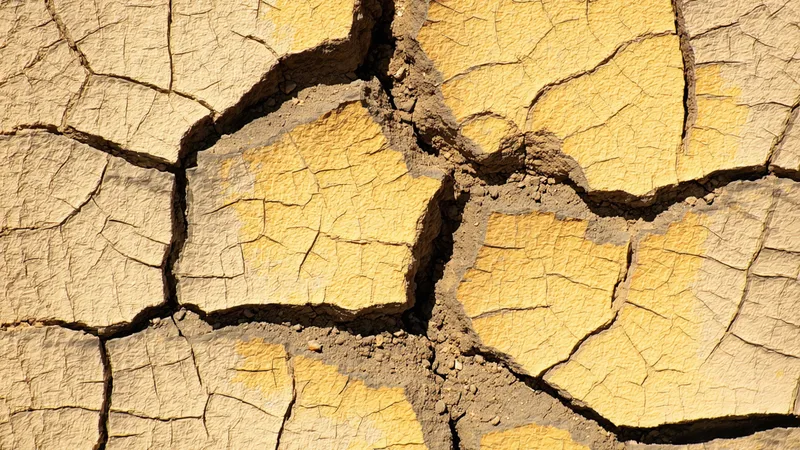
Arizona has been through three consecutive below-normal precipitation years. The Colorado River shortage declarations — Tier 1 in 2022, Tier 2 in 2023, continued shortage management through 2024 — are the water supply story that's getting press coverage. The infrastructure story that's unfolding simultaneously is less visible but has direct consequences for utility operations and capital planning: prolonged drought is changing the soil stress environment under Phoenix-area distribution networks in ways that are accelerating pipe failure rates.
This post is about what we're observing in the break event data from utilities in the Watsynq pilot cohort, the physical mechanisms that explain it, and what the data suggests about near-term failure risk in the central Phoenix distribution grid's aging cast iron segments.
The subsidence connection
Land subsidence caused by groundwater depletion is a well-documented phenomenon in Arizona. The Arizona Land Subsidence Group and ADWR have tracked subsidence rates across the Phoenix Active Management Area for decades. The most significant subsidence in the Phoenix metropolitan area occurred during the period of heavy groundwater pumping before Colorado River water delivery via the Central Arizona Project — some areas saw vertical land surface movement of several feet over decades. CAP water delivery and artificial recharge reduced subsidence rates substantially after the 1990s.
The recent drought period has reactivated a version of this dynamic on a smaller scale. Utilities that shifted toward increased groundwater pumping to compensate for reduced CAP allocations under shortage conditions have contributed to localized drawdown in aquifer zones that had been stable for years. The resulting differential settlement — not uniform land surface lowering, but variable, localized subsidence in areas of higher pumping draw — imposes differential strain on buried pipe that crosses the subsidence gradient.
Differential settlement is more damaging to rigid pipe materials than uniform subsidence. A cast iron main that settles uniformly along its length will flex at its joints and typically remain intact. The same main crossing a subsidence gradient — where one end of a segment settles 15mm and the other end settles 5mm over a three-year period — experiences a longitudinal bending load that concentrates stress at the joints and at any existing corrosion pits. That mechanism doesn't produce an immediate failure, but it advances existing structural compromise.
What the break rate data shows
In the break event datasets from growing utilities in the Watsynq cohort — representing networks across Maricopa and Pinal counties — we've been tracking the temporal distribution of break events relative to drought severity indices. The pattern that's emerged over the past three years is consistent with the theoretical soil stress mechanisms:
Break rates in networks with high concentrations of pre-1975 unlined cast iron, in areas of documented subsidence gradient history, have increased by 15–30% in the trailing 24 months compared to the preceding 5-year average. The increase is not uniform across all pipe materials — newer ductile iron segments in the same networks show no comparable rate increase. The geographic clustering of the break rate increase aligns with subsidence-prone soil areas (lacustrine deposits, fine-grained alluvial soils with high moisture-retention capacity) more than it aligns simply with the oldest pipe concentrations.
This pattern is consistent with a drought-driven soil stress mechanism, not just aging deterioration. If it were purely age-related, the rate increase would be more uniform across all segment types and vintage classes.
The temperature cycling amplifier
There's a second stressor operating simultaneously that gets less attention than drought-driven soil movement: extreme temperature cycling. Phoenix's summer temperatures — consistently above 110°F at the surface — drive significant thermal expansion in shallow-buried distribution mains, particularly in corridors with little shading from tree cover or buildings. The thermal expansion in a 12-inch cast iron main between a 40°F winter night and a 115°F summer surface temperature amounts to several millimeters of linear expansion per hundred feet, not enough to cause failure in good pipe, but enough to accumulate fatigue at already-compromised joints over years of cycling.
The combination of thermal cycling, drought-driven differential settlement, and the cyclic shrink-swell loading from monsoon events creates a multi-stressor fatigue environment that Phoenix-area distribution mains are dealing with that their counterparts in more temperate climates are not. Standard pipe deterioration curves — which were developed from failure data in diverse national utility databases — underpredict failure rates in this specific multi-stressor environment. That's part of why generic age-based asset management frameworks produce less accurate prioritization in the Southwest than in the Northeast or Midwest, and why localizing the model to Southwest soil and climate conditions matters for model accuracy.
Implications for the near-term risk window
The drought stress that has accumulated in soil profiles under Phoenix-area distribution networks over the past three years doesn't dissipate immediately when precipitation returns to normal. Soil that has undergone compaction and structural rearrangement during extended dry periods reacts to wetting through a complex consolidation process that can increase soil movement — and therefore pipe stress — during the initial recovery period. The first wet season following a multi-year drought can be a high-risk period for old cast iron in susceptible soil areas.
For utilities planning their capital replacement queue for 2026–2027, we'd suggest specifically examining the break rate trend in corridors that combine three characteristics: pre-1975 unlined cast iron, documented subsidence-prone soil classification, and high pressure zone cycling frequency. Those three factors together define the segments at highest elevated risk given the current drought-stress accumulation in Arizona's soil profile. They may not be your oldest pipe, and they may not be in the corridors that have historically broken most frequently — but the combination of current soil state and pipe condition makes them candidates for earlier-than-planned intervention.
A note on data availability for this analysis
The analysis I've described above requires a temporal break rate dataset that most utilities are not actively monitoring. If you're not tracking year-over-year break frequency by pipe vintage, material, and soil classification — and very few utilities are, because the CMMS reporting tools don't make that cut easy — you won't see the signal until it's already a significant operational problem.
One of the things we built into the Watsynq platform specifically for Southwest utilities is a drought-period risk modifier: when regional drought severity indices cross defined thresholds, risk scores for cast iron segments in subsidence-prone soil areas are automatically elevated to reflect the current environmental loading. That's not a substitute for the infrastructure investment that aging mains in drought-stressed soil areas require, but it does ensure that the next emergency response is going to the right segment rather than the wrong one.
Ethan Morales is CEO and Co-Founder of Watsynq, based in Phoenix, Arizona.