Reduce main breaks and prove it to your rate commission
Municipal water utilities face a hard combination: aging cast iron and AC pipe networks, SDWA compliance deadlines, and a rate commission that wants data-backed justification before approving capital replacement programs.
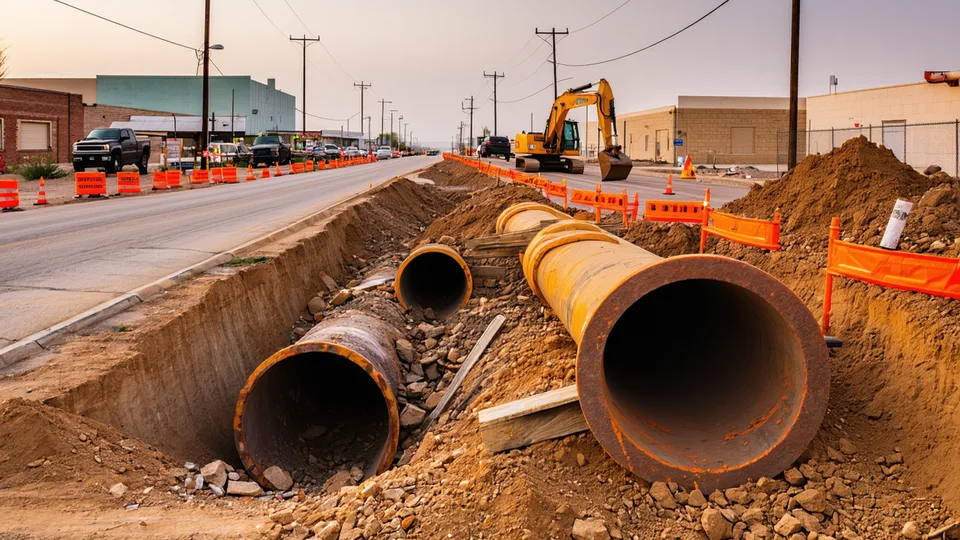
Three compounding pressures Watsynq directly addresses
Watsynq is a distribution analytics platform, not a capital program management tool. We tell you which segments to target and give you the data to justify the investment — your capital planning and procurement workflows stay exactly as they are.
Reactive break cycle
Emergency response to main breaks consumes 40–60% of distribution maintenance budgets for utilities with networks older than 30 years. Each reactive dig costs 3–7× more than a proactive replacement.
SDWA compliance monitoring
EPA Lead and Copper Rule revisions and the new PFAS Maximum Contaminant Level regulations require enhanced distribution-level monitoring. WQ sensor integration satisfies multiple monitoring requirements with a single deployment.
Capital justification
Rate commissions increasingly require quantitative risk-based justification for replacement capital. An intuition-based "we think these pipes are old" argument rarely passes commissioners who are managing rate affordability pressure.
From reactive maintenance to predictive operations
Onboarding: 14-day network mapping
We ingest your GIS pipe data, CMMS break records, and SCADA pressure historian. ML baseline is established. WQ sensor nodes are installed at high-priority junctions — typically 8–12 for a pilot network of 50–100 segments.
Weeks 2–8: Risk profile calibration
The risk model updates as telemetry accumulates. You begin seeing which segments are generating the most alert events and pressure anomalies. Staff start using the dashboard as a daily operations reference.
Month 3: Capital priority report
First capital planning output: top 25 highest-risk segments by expected annual cost exposure. Formatted for direct use in rate commission presentations, with supporting data appendix showing model inputs and validation against your historical break records.
Ongoing: break prediction, not just reporting
Risk scores update hourly. When a segment's composite score crosses 80, operations staff receive a proactive notification with recommended inspection or pre-emptive isolation review — before the break happens.
Qualified municipal utilities receive a subsidized 90-day pilot.
We cover sensor hardware costs for qualifying pilots on networks of 50+ segments. You provide SCADA historian access and GIS data. Within 90 days, you'll have a risk map, a capital priority shortlist, and enough model performance data to make a go/no-go decision on a full District contract.